What is a Group Company Mutual?
A group company mutual is a type of mutual which has been specifically designed to operate within a group company ...

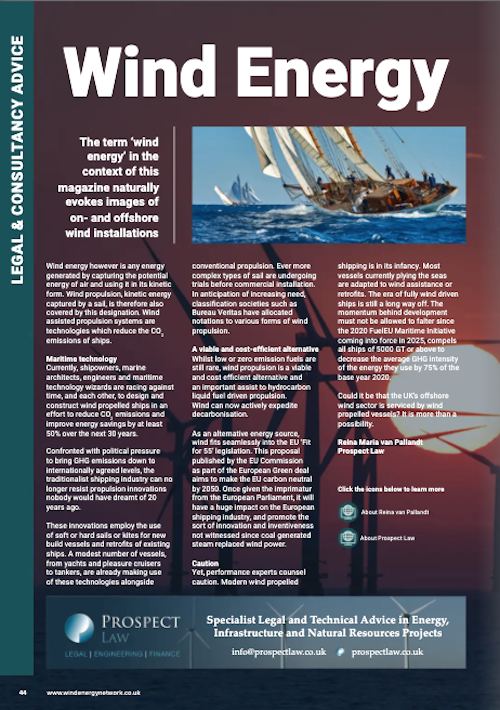
Our latest article for Wind Energy Network Magazine in which our maritime specialist, Reina Van Pallandt discusses the benefits of wind energy or wind propulsion to meet climate goals and how the maritime industry is responding.
The term ‘wind energy’ in the context of this magazine naturally evokes images of on- and offshore wind installations.
Wind energy however is any energy generated by capturing the potential energy of air and using it in its kinetic form. Wind propulsion, kinetic energy captured by a sail, is therefore also covered by this designation. Wind assisted propulsion systems are technologies which reduce the CO2 emissions of ships.
Currently, shipowners, marine architects, engineers and maritime technology wizards are racing against time, and each other, to design and construct wind propelled ships in an effort to reduce CO2 emissions and improve energy savings by at least 50% over the next 30 years. Confronted with political pressure to bring GHG emissions down to internationally agreed levels, the traditionalist shipping industry can no longer resist propulsion innovations nobody would have dreamt of 20 years ago. These innovations employ the use of soft or hard sails or kites for new build vessels and retrofits of existing ships. A modest number of vessels, from yachts and pleasure cruisers to tankers, are already making use of these technologies alongside conventional propulsion. Ever more complex types of sail are undergoing trials before commercial installation. In anticipation of increasing need, classification societies such as Bureau Veritas have allocated notations to various forms of wind propulsion.
Whilst low or zero-emission fuels are still rare, wind propulsion is a viable and cost efficient alternative and an important assist to hydrocarbon liquid fuel driven propulsion. Wind can now actively expedite decarbonisation. As an alternative energy source, wind fits seamlessly into the EU’s ‘Fit55’ legislation. This proposal published by the EU Commission as part of the European Green deal aims to make the EU carbon neutral by 2050. Once given the imprimatur from the European Parliament, it will have a huge impact on the European shipping industry, and promote the sort of innovation and inventiveness not witnessed since coal generated steam replaced wind power.
Yet, performance experts counsel caution. Modern wind propelled shipping is in its infancy. Most vessels currently plying the seas are adapted to wind assistance or retrofits. The era of fully wind-driven ships is still a long way off. The momentum behind its development must not be allowed to falter since the 2020 FuelEU Maritime Initiative coming into force in 2025, compels all ships of 5000 GT or above to decrease the average GHG intensity of the energy they use by 75% of the base year 2020.
Could it be that the UK’s offshore wind sector is serviced by wind propelled vessels? It is more than a possibility.
To read the full Wind Energy Network Magazine click here

Reina Maria van Pallandt is a senior disputes resolution lawyer with dual British and Dutch nationality. After obtaining an LLB Honors degree in Dutch Law and Public International Law at the University of Amsterdam (UvA), Reina Maria studied International Law of the Sea at London School of Economics (LSE).
Read more about Reina
Prospect is a multi-disciplinary practice with specialist expertise in the energy and environmental sectors with particular experience in the low carbon energy sector. The firm is made up of lawyers, engineers, insurance and risk management specialists, and finance experts.
This article remains the copyright property of Prospect Law Ltd and neither the article nor any part of it may be published or copied without the prior written permission of the directors of Prospect Law.
This article is not intended to constitute legal or other professional advice and it should not be relied on in any way.
Further Reading
A group company mutual is a type of mutual which has been specifically designed to operate within a group company ...
On 5th May a storm broke out in European legal and political circles:Germany’s most senior judges had dared ...
In this article, Dominic Whittome covers recent changes to wholesale energy prices. Oil Energy prices continued to climb across the ...
The UK government’s move to introduce a bespoke regulatory framework for captive insurers represents a notable shift in the ...
There are a variety of different risk transfer and types of Mutual Structures available for deployment. The commonality between them ...
On 9th November 2021 the Environment Act 2021 finally completed its passage through Parliament, a tortuous passage that had taken over 600 days ...